 Sunvim Motor
China’s motor market spans large industrial groups, specialized factories, and export-focused suppliers. This guide introduces ten Chinese manufacturers of Asynchronous Motor products, with attention to engineering capability, product range, and practical support. The list is a starting point, not a universal ranking. A company’s suitability depends on the application.
Asynchronous motors are widely used in pumps, fans, compressors, conveyors, and other equipment because their design is robust and familiar to maintenance teams. Yet “standard” does not mean interchangeable. Frame size, rated power, voltage, frequency, insulation class, enclosure protection, efficiency, and operating duty all matter. A motor destined for a dusty workshop may need different protection from one installed indoors. Small details count.
Nikola Tesla, whose induction-motor work helped shape modern alternating-current machinery, wrote: “The scientific man does not aim at an immediate result.” That spirit suits supplier evaluation: a datasheet is useful, but not the whole story. Ask about testing, production consistency, documentation, delivery terms, and after-sales assistance. Request evidence that matches the intended operating conditions. Then compare it.
A polished catalog can still leave important questions unanswered. That deserves attention. This overview therefore encourages readers to verify specifications directly with each manufacturer and to distinguish published claims from independently confirmed information. The strongest choice is not automatically the largest supplier or the lowest-priced offer. It is the one whose technical fit, quality controls, and support align with the equipment’s real duty.
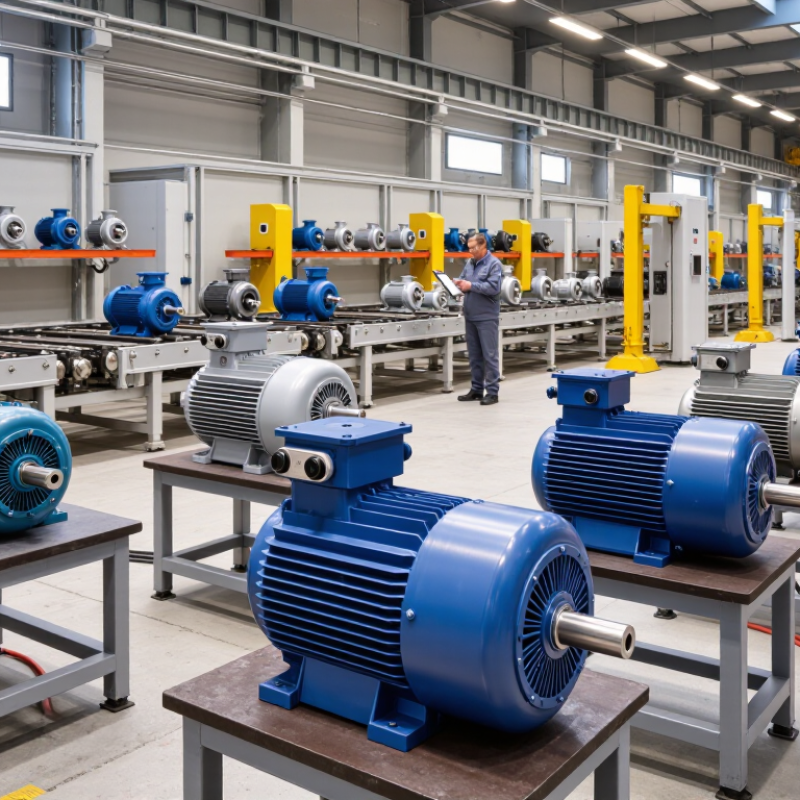
An asynchronous motor, also called an induction motor, converts electrical energy into rotation through electromagnetic induction. Alternating current in the stator creates a rotating magnetic field. This field induces current in the rotor, producing torque without a direct electrical connection to it. In common squirrel-cage designs, conductive bars sit inside the rotor, much like a sturdy metal cage. The rotor turns slightly slower than the magnetic field. That small gap matters. Without it, induction and torque would fall away.
The speed difference is called slip, and it changes with load. A motor driving a lightly loaded fan may run closer to synchronous speed than one turning a heavy conveyor. A common mistake is treating the nameplate speed as fixed under every condition. It is not. Supply frequency, pole count, load, and motor design all affect operating speed. The International Energy Agency’s 2011 report, Energy-Efficiency Policy Opportunities for Electric Motor-Driven Systems, estimates that motor-driven systems account for about 45% of global electricity use. That scale makes efficiency and correct sizing practical concerns, not minor details. Yet a motor’s real performance also depends on its driven equipment and operating conditions. A datasheet alone cannot tell the whole story.
An asynchronous motor, also called an induction motor, converts electrical energy into mechanical energy through electromagnetic induction. Its rotor turns at a speed slightly different from the rotating magnetic field produced by the stator; this difference is called slip. The table below compares ten common asynchronous-motor product types. It is a product-category overview, not a ranking of manufacturers.
| No. | Motor Type | Typical Design or Feature | Common Applications | Selection Notes |
|---|---|---|---|---|
| 1 | Three-Phase Squirrel-Cage Motor | Rugged, brushless induction design; commonly supplied for low-voltage industrial power systems. | Pumps, fans, compressors, conveyors, and general machinery. | A widely used general-purpose option; check rated power, voltage, frequency, mounting, and efficiency class. |
| 2 | High-Efficiency Induction Motor | Designed to reduce operating losses; efficiency classes are defined in standards such as IEC 60034-30-1. | Equipment with long operating hours and steady or frequently repeated duty. | Compare the motor’s stated efficiency class and rating at the required frequency and load. |
| 3 | Inverter-Duty Induction Motor | Specified for variable-frequency-drive operation; insulation and cooling requirements depend on the speed range and drive conditions. | Variable-speed pumps, fans, mixers, and production lines. | Confirm the permitted frequency range, low-speed cooling, insulation system, and drive compatibility. |
| 4 | Single-Phase Capacitor-Start Motor | Uses a start capacitor and auxiliary winding to improve starting torque; the starting circuit is typically switched out after starting. | Small pumps, compressors, and machines supplied from single-phase power. | Check the required starting torque, supply voltage, and start frequency. |
| 5 | Single-Phase Capacitor-Run Motor | A run capacitor remains in the auxiliary winding circuit during operation. | Fans, blowers, and other equipment requiring smooth operation on single-phase supplies. | Verify the load characteristics and the motor’s rated capacitor specifications. |
| 6 | Single-Phase Dual-Capacitor Motor | Uses separate start and run capacitors to provide starting assistance and support operation. | Applications needing stronger starting performance from a single-phase supply. | Check the starting duty and capacitor-switching arrangement specified by the manufacturer. |
| 7 | Brake Induction Motor | Combines an induction motor with a braking unit, commonly an electrically released brake. | Hoists, lifting equipment, machine tools, and material-handling systems. | Select braking torque, stopping frequency, and brake supply to match the application. |
| 8 | Explosion-Protected Induction Motor | Built and certified for specified hazardous-area classifications and protection requirements. | Certain chemical, oil and gas, mining, and dust-hazard environments. | Match the certification, gas or dust group, temperature class, and area classification to the site. |
| 9 | High-Voltage Induction Motor | Three-phase motor designed for higher-voltage systems; ratings and construction vary by application. | Large pumps, compressors, fans, and heavy industrial drives. | Confirm system voltage, starting method, insulation requirements, and site installation conditions. |
| 10 | Wound-Rotor Induction Motor | Uses a wound rotor connected through slip rings, allowing external rotor resistance in suitable designs. | Some heavy-duty drives requiring controlled starting or particular torque characteristics. | Consider the starting method, control equipment, maintenance needs, and operating duty. |
Specifications vary by design and supplier. Confirm all ratings, efficiency data, protection ratings, and certifications against the motor nameplate and technical documentation before selection.
It converts electrical energy into rotation through electromagnetic induction. Alternating current in the stator creates a rotating magnetic field.
The rotating field induces current in the rotor, producing torque. In a squirrel-cage design, conductive bars form a sturdy cage inside the rotor.
Slip is the speed difference between the rotor and the rotating magnetic field. That small gap matters.
No. Supply frequency, pole count, load, and motor design affect operating speed. A lightly loaded fan may run faster than a heavily loaded conveyor.
Compare rated output, efficiency class, insulation, cooling method, and bearing options. Frame dimensions and nameplate data also give useful clues.
No. It does not show performance at every operating load. Published test conditions help, but public information may still leave gaps.
Look for test-bench procedures, maintenance support, and customization capacity. A clear frame drawing can help check whether a motor fits existing equipment.
Actual performance depends on the driven equipment and operating conditions. A datasheet is useful, but it can feel incomplete without consistent test data.
This article introduces the Asynchronous Motor, explaining its basic operating principles, key components, and common advantages in industrial use. It also reviews how China’s motor industry has developed through improvements in manufacturing capacity, product design, quality control, and international trade. Readers will find practical criteria for evaluating manufacturers, including technical expertise, production capabilities, testing procedures, certifications, customization options, and after-sales support.
The article also presents an overview of ten leading Chinese manufacturers without focusing on brand promotion, highlighting the kinds of products and capabilities buyers may encounter. It explores applications across sectors such as manufacturing, construction, agriculture, and infrastructure, along with relevant standards and export considerations. Together, these topics offer a useful starting point for comparing suppliers and selecting motors that suit operational requirements, performance expectations, and market needs.
